
Sources for South Pasadena Previous Residents
A house-history trail is strongest when each source owns a distinct time or fact. Los Angeles County's recorder has real-estate instruments from 1850 forward, but the index is not available on the open web. South Pasadena Public Library directories begin in 1893, with selected reverse years that move from address to occupant. Newspapers, permits, census schedules, and Sanborn maps fill the spaces between deed events.
| Source | Verified coverage | Where held | What it contributes |
|---|---|---|---|
| Recorded real estate | 1850 to present | Los Angeles County RR/CC | Owners, instruments, legal parcel, recording date |
| City directories | 1893 to present physical; 1893 to 1962 online | SPPL and Internet Archive | Listed adults, addresses, occupations |
| Reverse sections | 1929 to 1947; 1955; 1958; 1961; 1974 | SPPL | Address to listed occupant |
| Newspaper microfilm | 1893 to present | SPPL | Obituaries, notices, property and social events |
| City Hall Archive MC0009 | 1902 to 1989 | SPPL appointment collection | Permits, maps, aerial photos, ledgers |
| Federal census | 1900 to 1950 public | NARA, partners, libraries | Household members, relationships, age, birthplace |
| Sanborn maps | Collection span 1867 to 1970 | LAPL card access or LOC | Footprints, use, street and numbering context |
Use the source closest to the question. Deeds are for legal ownership, directories for listed people, census for household structure, and maps for the physical setting. None is a full list of everyone who passed through a house.
Begin South Pasadena Previous Resident Research
The current parcel is the anchor because a street address can be spelled or renumbered in older material. Enter the address in the Los Angeles County Assessor Portal, save the AIN, legal description, building facts, and roll date, then use the map to check the polygon. Owner names are not displayed on the public website. The Assessor's controlled channels include district offices, Property Data Sales, and a help-desk inquiry that supplies the AIN and property address.
Homeowner Notification and e-Notification can alert a current owner to specified new ownership, loan, default, or sale recordings. That service is a fraud-monitoring channel, not a retrospective history of previous residents. It can protect the current record while the deed chain is researched through RR/CC.
The Los Angeles County Homeowner Notification Program explains the alert route.
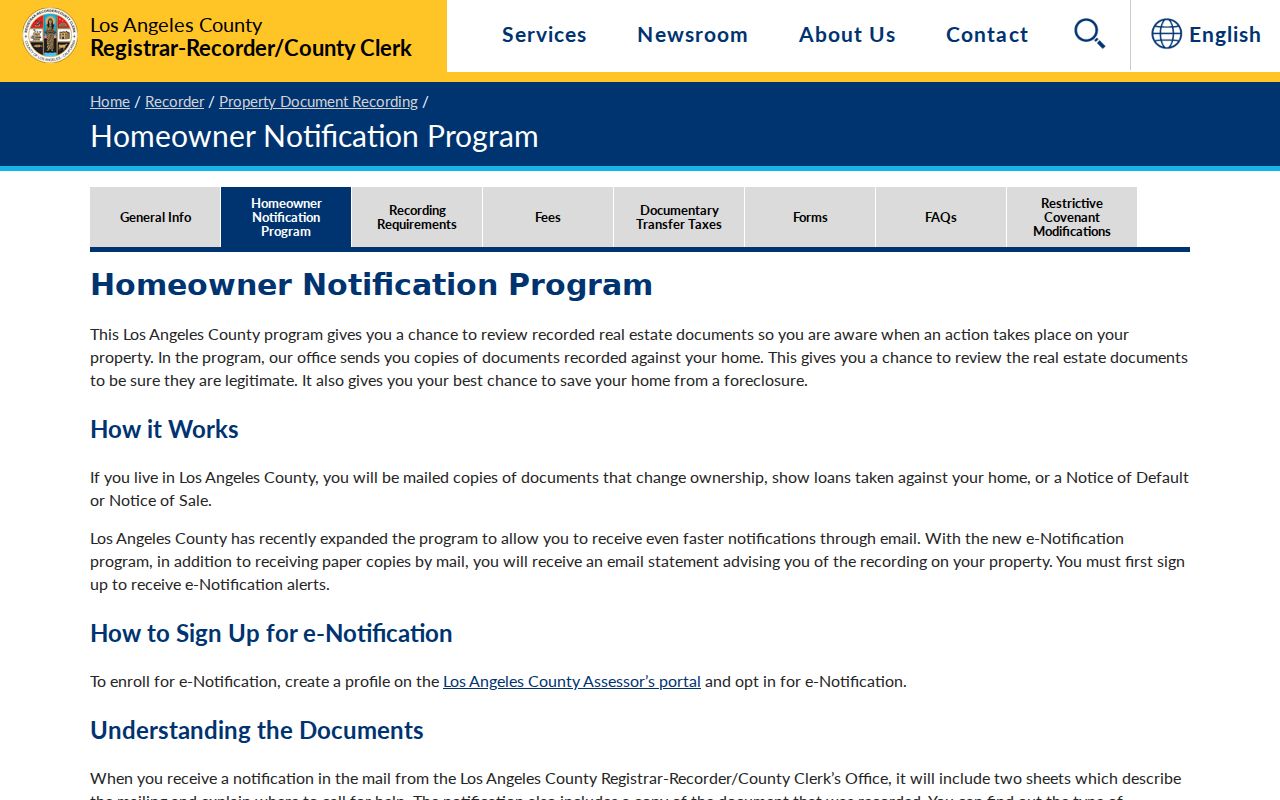
Save the parcel key before moving into the past. A notice may flag a new filing, but the instrument and legal description still control the historical claim.
Trace the South Pasadena Deed Records
Los Angeles County RR/CC holds recorded property documents from 1850 to the present. It does not publish an open online grantor and grantee index, and it cannot begin a real-estate request from a street address or APN. The bridge is address to AIN to controlled owner channel to party name and likely recording year. Once the current purchase deed is found, the seller becomes the next search target.
- Search the present address in the Assessor Portal and preserve the AIN and legal description.
- Obtain the assessed owner through the permitted Assessor counter, help desk, or data channel.
- Search that owner as grantee around the likely purchase year using RR/CC's counter or order route.
- Read the deed for grantor, grantee, recording date, document number, and legal description.
- Search the seller as an earlier grantee, repeat the comparison, and mark uncertain trust or title transfers.
- Grantor
- The party transferring an interest in the recorded instrument.
- Grantee
- The party receiving the interest in that instrument.
- Chain of title
- The linked sequence of recorded transfers for a parcel.
- Legal description
- The land description that can identify the parcel when the street label changes.
The Los Angeles County Registrar-Recorder/County Clerk gateway is the county entry point for real-estate and clerk services.
The county gateway reflects the real access model: a party and year are more useful than a promise of an address-first web search.
Repeat South Pasadena Deed Sellers
After a purchase deed names the seller, search that seller as a grantee in earlier years. Compare the legal description or AIN to the target parcel before adding the instrument to the chain. A deed of trust, reconveyance, lien, or trust transfer can look like a sale if the instrument type is ignored. Record the instrument title and role for every link.
RR/CC access includes free viewing by appointment, online or mail and fax copy requests, and participating branch routes. The official fee schedule lists a plain copy at $5 for the first page plus $3 for each additional page, a certified copy at $6 plus $3, a name-and-year search at $0.50 with a $1 minimum, and a $1.75 credit-card handling charge. These amounts are time-sensitive, so recheck before ordering.
The RR/CC real-estate records fee page is the source for the current schedule.
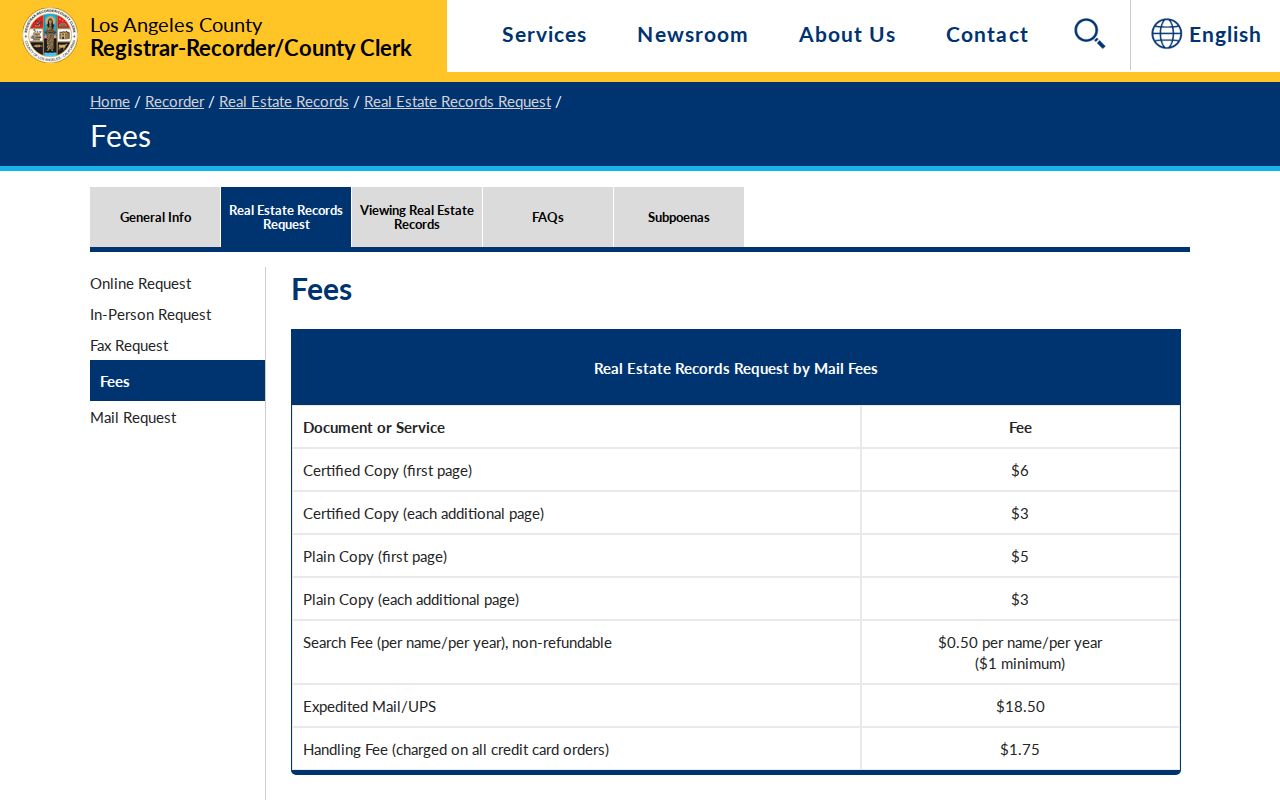
Fee detail helps choose between viewing and ordering. It does not change the rule that the record must be matched to the parcel.
Assessor help also warns that transfer-tax-derived sale-price displays can carry copied terminal digits, such as a display ending in $450,004. Let the deed and transfer declaration control instead of inferring a precise consideration from a portal number.
Reverse Directories for South Pasadena Addresses
Owners are only one half of previous residents research. The South Pasadena Library's reverse sections move from street and house number to a listed occupant in 1929 through 1947, 1955, 1958, 1961, and 1974. Alphabetical years can still help when a surname comes from a deed, census, newspaper, or family paper. Browse nearby house numbers and both sides of a block when an old address is uncertain.
The library's full city-directory run covers 1893 to the present physically, with older scans online through 1962. A typical entry may carry a spouse or widow notation, occupation, employer, home marker, and street line. The reverse entry may omit children or other adults. Treat a first appearance as an interval and a disappearance as a prompt for the next source.
The South Pasadena House Research guide explains the reverse years and the local address-history workflow.
Pair South Pasadena Previous Occupants
A deed names a legal party. A directory names a listed adult. A census records a household in an enumeration year. Those are not interchangeable. An owner may receive tax mail elsewhere. An occupant may be a renter. A census household may include people omitted from a directory. A good previous residents trail labels each source rather than turning all names into owners.
Pair one directory year with the closest census, then use newspapers for an obituary, marriage, arrival, club, or property event. Use permits and the City Hall Archive to date construction, additions, or demolition. The Archive's demolished-building permit series can explain why a directory address disappears while the parcel remains.
A dated pairing keeps a household clue from becoming a false continuous story:
- Choose the nearest available directory year to the event or address date.
- Copy the listed name, address, spouse or widow mark, and any abbreviation exactly.
- Check the closest public census year for household members, relationships, age, and birthplace.
- Use newspapers, probate, vital records, or permits to test a move, death, marriage, or building change.
- Label each fact by source and year, then mark gaps instead of filling them with an assumption.
For the collection itself, use the South Pasadena city directory archive. For the current parcel-to-party bridge, use the South Pasadena street directory workflow.
South Pasadena House History Clue
Orange Grove Place was formerly Fell Street in the 1906 McCament Tract. That rename is a practical warning for anyone following previous residents backward. Search the old and new names, compare cross streets, and check the tract, lot, or parcel before deciding that two entries describe different places. Mission Street, Fair Oaks Avenue, Huntington Drive, Meridian Avenue, Oaklawn, Marengo, and Monterey Hills can serve as geographic anchors in a scan.
Planning material divides built history into periods such as Town Settlement from 1873 to 1899 and Mid-Century Modern from 1945 to 1963. Oaklawn's development is associated with 1905 to 1915. These facts help place a structure in time, but they do not identify a household by themselves. A map explains the building and street context; a directory or deed supplies the named record.
The Library of Congress Sanborn map collection is a useful catalog route, while exact South Pasadena sheets and editions still need to be selected.
South Pasadena Sanborn Map Buildings
Sanborn fire-insurance maps can show a footprint, construction material, use, street name, numbering context, and changes to a structure. The research records a database collection span of 1867 to 1970, but it does not enumerate every South Pasadena sheet or edition. A map therefore supports a house-history trail without replacing the deed or directory.
Compare the map to the Assessor polygon and a city permit. A demolition permit, addition, or changed footprint can explain why a prior address looks absent. The map can also show why a modern unit count does not match an old single-house entry. It cannot usually name the family that occupied the building.
When a map or scan is hard to use, ask the South Pasadena Local History desk about the house-research guide, the reference shelf, and handling rules.
Close a South Pasadena Previous Trail
The final link often comes from newspapers, probate, or a vital record rather than another deed. The library's newspaper microfilm begins in 1893 and can be searched for obituaries, marriages, arrivals, clubs, school events, and property notices. Probate can name a decedent, petitioner, personal representative, or heirs in public filings. Vital copies have eligibility rules and may be authorized or informational.
California's 2026 CDPH fee schedule lists $31 for birth, $26 for death, $19 for marriage, and $18 for dissolution. CDPH reported about four to six weeks for certified copies and seven to nine weeks for amendments in its July 9, 2026 update. A court copy request has its own fee and confidentiality rules. Confirm the current schedule at order time rather than copying a historical amount into a research note.
The California vital-record fee page shows the state schedule.
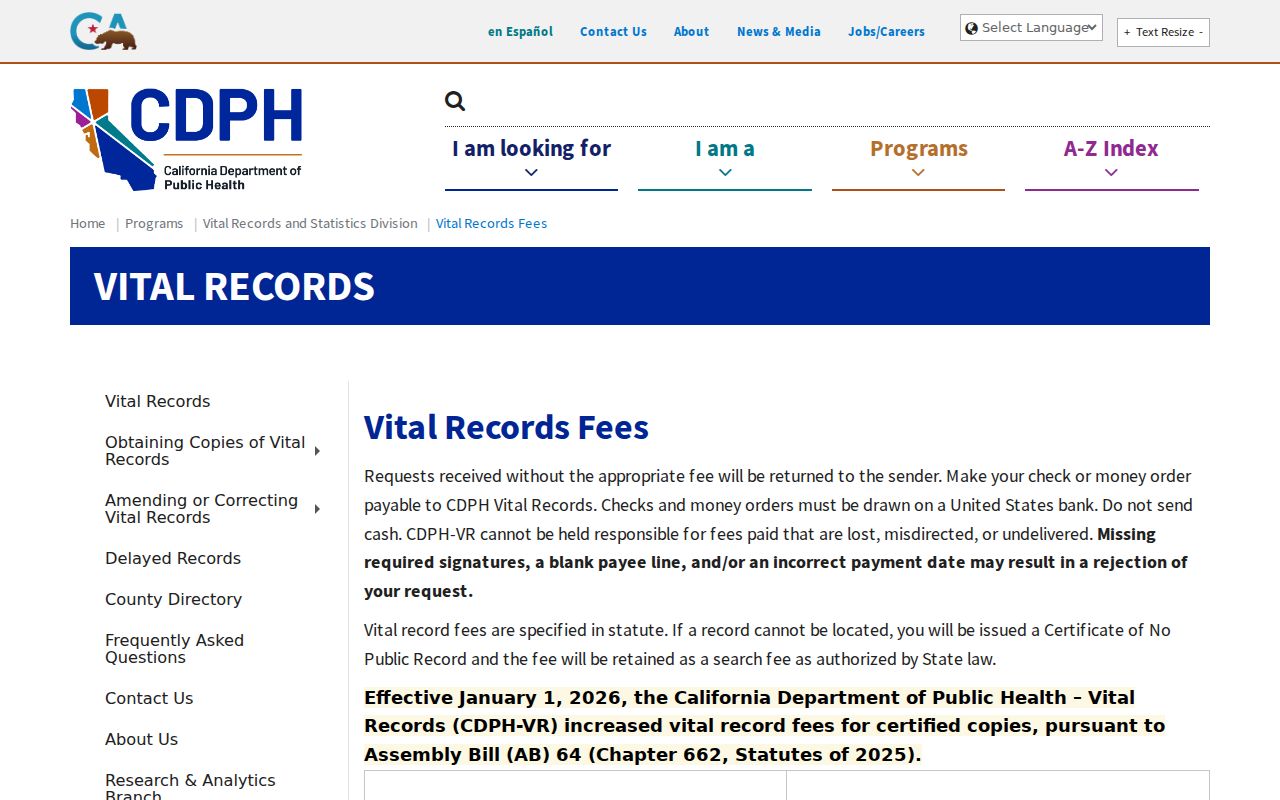
A vital record confirms an event only within its access rule. It can close a family-history gap without proving that every address in the deed chain was a residence.
The California Courts copy guidance explains the court route for a public file.
A court copy can add a date or relationship when the file is public. Sealed, juvenile, adoption, and confidential material must remain outside the trail.
Lawful house history. Previous residents research is for family history, preservation, and personal curiosity. Do not use a living person's old address trail to stalk, harass, threaten, or track them.